Changes in Sulfur Deposition Over Time
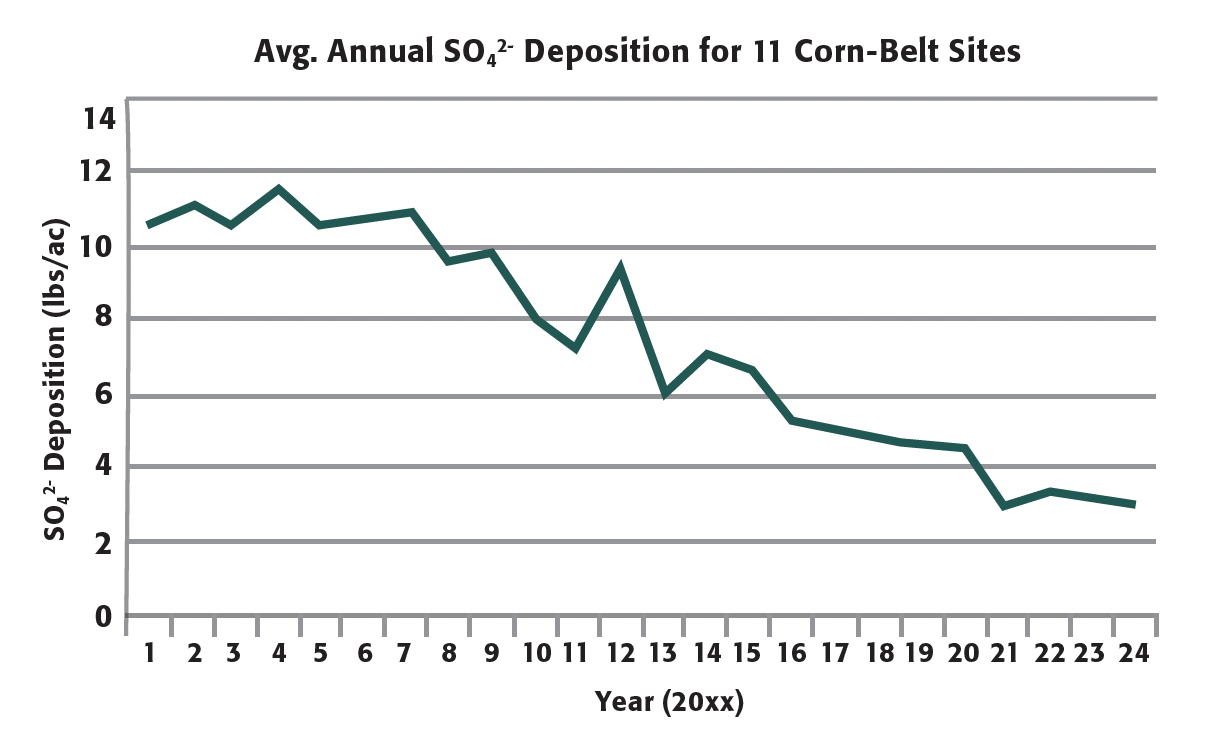
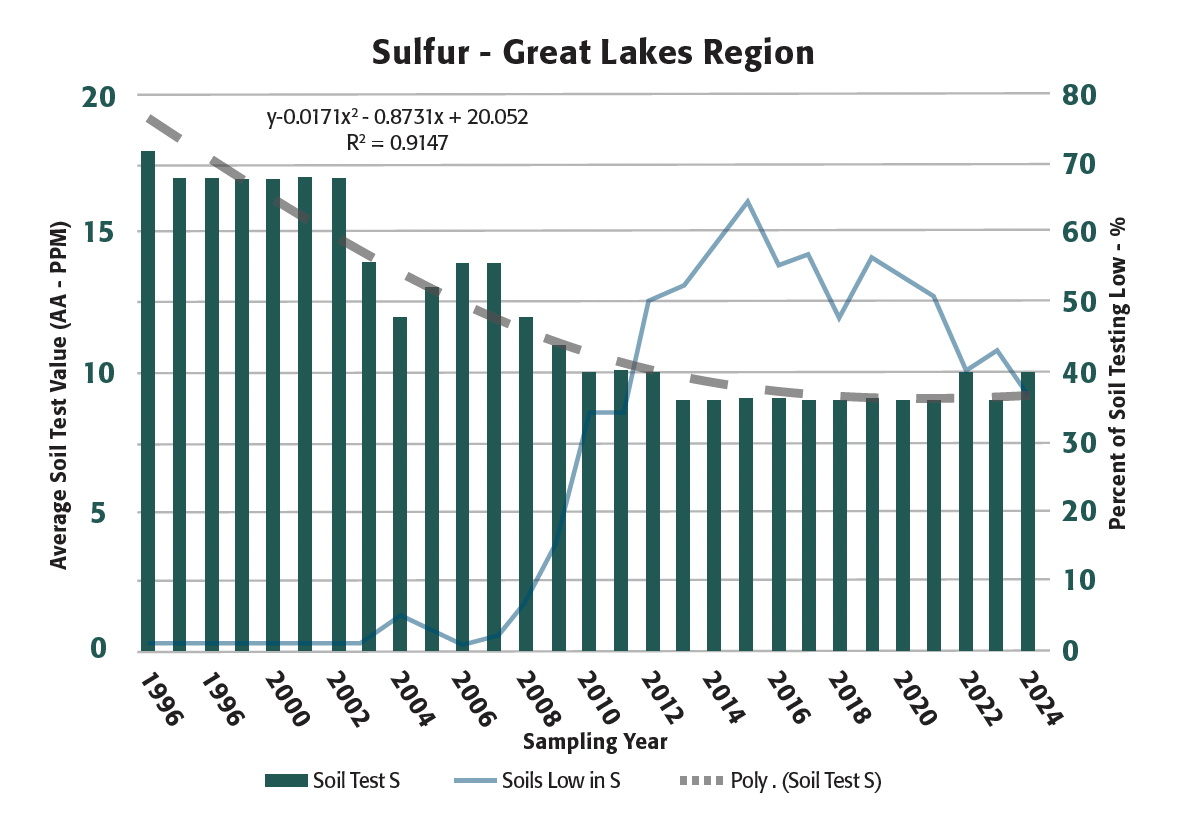
Historically, atmospheric sulfur deposition from industrial emissions, compound fertilizers, and pesticides provided a background supply of plantavailable sulfur. This external sulfur input often met or exceeded crop demands, reducing the need for additional sulfur fertilization. However, air quality regulations, such as the U.S. Clean Air Act, significantly reduced sulfur emissions leading to a 34–86% decline in atmospheric sulfur deposition between 2000 and 2020 across North America1,2. In the Midwest, sulfur deposition once ranged from 10–20 lbs of S per acre per year, but today, many regions receive less than 5 lbs of S per acre per year from deposition (Figure 1)2,3. Cleaner processes and advanced chemical production have also reduced unintended sulfur content in fertilizer and pesticides as well. The reduction in S as a co-product and atmospheric precipitate has created a gap in sulfur availability that must now be met through fertilization, a gap that has been further exacerbated by increased crop yields. Recent studies indicate that soil reserves of plant-available sulfur are steadily decreasing in many intensively farmed areas (Figure 2), particularly in coarse-textured soils with low organic matter4. Sufficient sulfur is important for proper residue cycling to organic forms, where N and S are typically paired at a 8:1 ratio to form soil organic matter1. Sulfur depletion leads to yield penalties in corn, wheat, and soybeans when not addressed; therefore, current sulfur fertilization strategies must compensate for the loss of past external S inputs to sustain crop productivity.
Increased Sulfur Rates & Prolonged Availability Required for Higher Yields
Modern high-yielding crop varieties require more sulfur than their predecessors due to increased biomass production, greater grain removal, and enhanced nitrogen utilization. Sulfur’s role in plant metabolism, enzyme activation, and stress tolerance is critical. As crop yields rise, the demand for sulfur has outpaced past application rates, necessitating adjustments in fertilizer strategies.
- Corn: Many current application rates exceed 40 lbs of S per acre or are based on N:S ratios as low as 5:1, a significant increase from past recommendations that were guided by the principle that corn takes up about 1 pound of S per every 10 bushels of corn, with a 250-bushel per acre crop requiring uptake of approximately 25 lbs of S per acre5,6. With at least 50% of corn’s S uptake happening during grain fill, S deficiencies lead to incomplete kernel development and lower grain protein. In addition, S deficiencies are exacerbated where high planting densities result in smaller roots systems which are unable to sufficiently explore the soil profile5.
- Wheat: Wheat sulfur requirements have increased as protein concentration and nitrogen efficiency become key production goals. Studies have shown that sulfur applications can improve nitrogen use efficiency by over 20%, leading to both yield gains, and improved grain quality7.
- Soybean and Legumes: Legumes require sulfur for protein synthesis and nitrogen fixation. Growers are moving soybean planting dates earlier to support higher yields, but cooler soils from earlier planting may subject plants to less mineralizable sulfur at key growth stages, particularly in low-organic-matter soils. Research suggests that applying 18–27 lbs of sulfur per acre at planting optimizes nodulation and late-season protein formation8.
Crop sulfur uptake varies based on soil type, microbial activity, and nitrogen availability, making it essential to adjust S fertilization based on plant uptake throughout the season rather than by the S removal of grain. By shifting the focus from sulfur removal to sulfur uptake, fertilization strategies can be better tailored to match crop needs, improve yield, and reduce nutrient losses.
Sulfur Recommendations Based on Uptake and Late-Season Availability
There are logistical challenges to meeting the season-long S uptake needs of today’s crops. Fertilizers that are sulfate based provide S to plants immediately, but it is subject to leaching. This makes it difficult to be sure that sulfate applied in the spring will still be sufficiently available later in the season to meet the crops demands. Multiple sulfate fertilizer applications per season can counter this challenge but comes with additional application costs.
- Elemental S requires time to oxidize into plant available forms, leading to potential early season deficiencies and resulting in only 5-15% of applied elemental S is available to the crop in the same growing season. This inefficiency makes elemental S a poor fertilizer choice to meet full season crop S demands.
- Utilizing co-granulated fertilizers such as MicroEssentials® provides sulfate sulfur to satisfy early crop S needs, and elemental sulfur with Fusion® technology which enables increased S oxidation to increase S availability later in the growing season. With three different formulations of MicroEssentials, there is a formulation available that balances the early and late season S needs for every major cropping system in North America.
Summary
Over the past 25 years, the landscape for crop sulfur demand has changed in many ways in North America. Declining sulfur deposition, decreasing soil test levels, and increased crop demand all suggest that farmers and agronomists must adopt more proactive sulfur management strategies to sustain productivity and environmental stewardship. The environmental benefits of sulfur fertilization make a strong case for increasing sulfur application rates to meet crop S uptake instead of crop S removal. Meeting these challenges with the proper S timing and rates can be accomplished with novel fertilizers such as MicroEssentials that provide two forms of S for season-long S availability.
References
- Sharma, R. K., et al. 2024.Revisiting the Role of Sulfur in Crop Production: A Narrative Review.Journal of Agriculture and Food Research, 15, 101013.
- Hinckley, E.-L. S., and C. T. Driscoll. 2022.Sulfur Fertiliser Use in the Midwestern US Increases as Atmospheric Sulfur Deposition Declines with Improved Air Quality.Communications Earth & Environment, 3, 324.
-
National Atmospheric Deposition Program (NRSP-3). 2025. NTN Interactive Map. NADP Program Office, Wisconsin State Laboratory of Hygiene, 465 Henry Mall, Madison, WI 53706.
- A&L Great Lakes Laboratories. 2025. Personal communication, May 30, 2025.
- Bender, R. R., et al. 2013. Modern Corn Hybrid’s Nutrient Uptake Patterns. Better Crops with Plant Food, 94, 7–19.
- Zenda, T., et al. 2021. Revisiting Sulfur—The Once Neglected Nutrient: Its Roles in Plant Growth, Metabolism, Stress Tolerance and Crop Production. Agriculture, 11(7), 626.
-
Zitong, Y., et al. 2021.
Impact and Mechanism of Sulphur-Deficiency on Modern Wheat Farming Nitrogen-Related Sustainability and Gliadin Content. Communications Biology, 4, 945. - Yingdong, B., et al. 2024. Combination Effects of Sulfur Fertilizer and Rhizobium Inoculant on Photosynthesis Dynamics and Yield Components of Soybean. Agronomy, 14, 794.